

Home appliances move heat, water, air, and electricity through systems we use every day. Refrigerators preserve food; washers, dryers, and dishwashers move water and heat; microwaves heat food; air conditioners remove room heat. Their jobs differ, but good troubleshooting starts the same way: describe what changed, protect people and property, check the exact model instructions, and favor reversible owner-level checks. This overview links six guides and explains where observation should stop.
Start with an observation, not a diagnosis
Describe what happens, when it happens, and what changed. “The washer fills and washes but leaves water after the rinse” identifies a cycle stage better than “it fails.” Record a message exactly; note unusual sounds or odors; photograph a leak or frost from a safe distance. Use the full model number from its rating label to find a procedure. Learn how to read a model number and review electronics safety basics.
Begin with owner-level checks: settings, a normally closing door, a visible hose kink, blocked airflow, or a filter the manual says is user-cleanable. Change one thing and compare the result. A familiar symptom or code does not prove a part failed; models and procedures differ. Avoid generic instructions that may describe another design.
Six kinds of work, six different boundaries
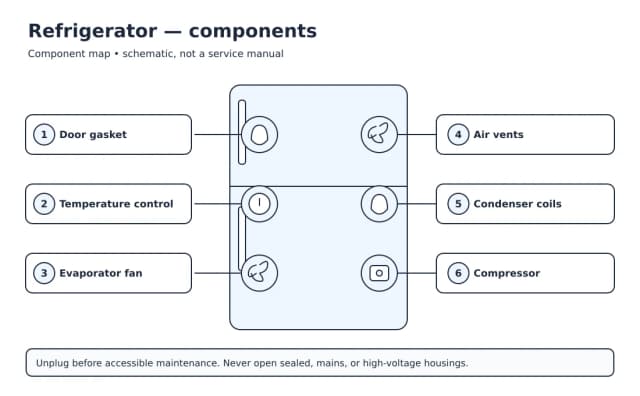
Refrigerators move heat out of the cabinet and need clear vents, sound door seals, and suitable room conditions. If food is warming, measure with a thermometer: FDA guidance is 40°F or below for the refrigerator and 0°F for the freezer. Blocked airflow, a defrost issue, and sealed-system faults can look alike. Check settings and package placement; leave sealed systems and energized components to professionals. See the Refrigerator Guide.
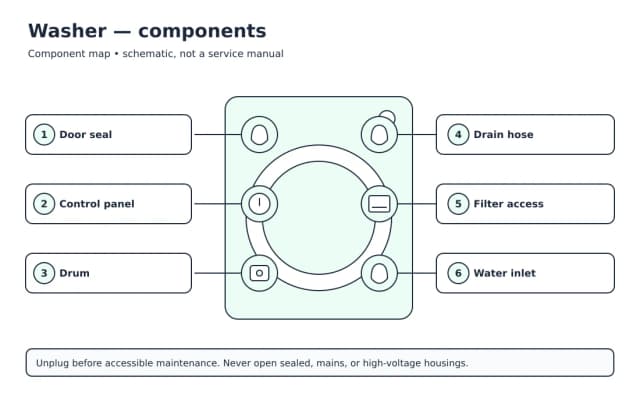
Washers fill, wash, drain, rinse, and spin. Wet laundry may follow an unbalanced load, excess detergent, a drain restriction, or cycle selection—not necessarily motor failure. Check the load and cycle, inspect visible hoses, and clean a pump filter only if the manual permits it. Stop if water reaches electrical parts; never cross standing water to reach power. See the Washer Guide.
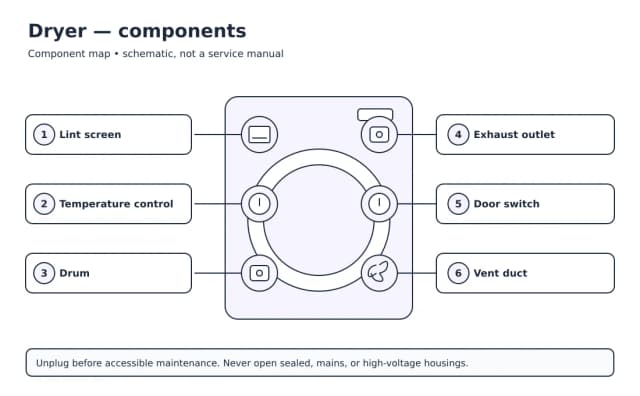
Dryers need a suitable cycle, room to tumble, and clear lint and exhaust paths. Clear the lint screen as directed and note whether air reaches the exterior outlet. Slow drying can mean a blocked vent or poorly extracted laundry; repeating hot cycles is not a safe shortcut. Stop for smoke, burning odor, scorching, or breaker trips. Leave gas and internal heating work to professionals. See the Dryer Guide.
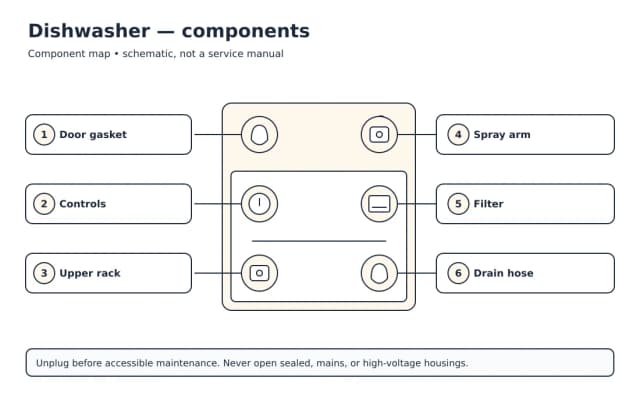
Dishwashers spray, heat, dry, and drain according to their model. Ensure dishes do not block spray arms, use specified detergent, and clean only an approved removable filter. Standing water, wet plastics, and odor call for different observations. Stop for water near wiring; do not reach into a running machine or remove fixed panels. See the Dishwasher Guide.
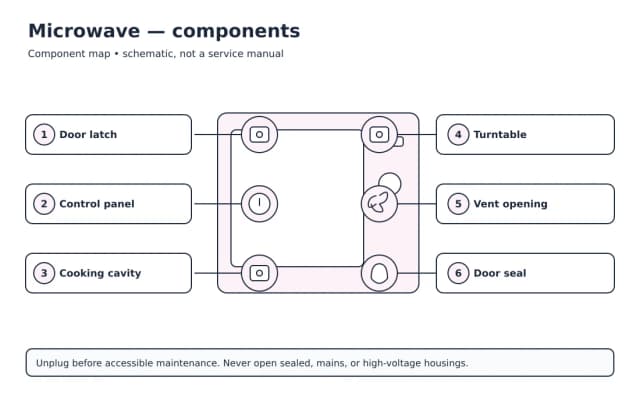
Microwaves allow external checks of settings, door closure, turntable seating, and—if safe—the outlet. Stop for persistent arcing or door, latch, seal, or enclosure damage. The high-voltage capacitor can hold a lethal charge even when unplugged: never open the cabinet or replace internal parts. For an internal fault, call a qualified technician or replace the unit. See the Microwave Guide.
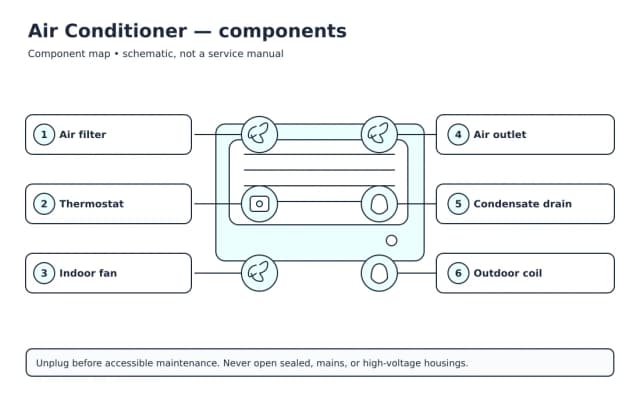
Air conditioners need clear airflow, a suitable filter, drainage, and correct installation. Owners may maintain filters as directed and confirm settings. Ice, noise, leaks, and failure to start have different causes; switch off cooling if ice forms and do not chip it. Refrigerant handling requires EPA Section 608 certification. Never recharge a unit; ask a licensed HVAC technician about suspected sealed-system faults. See the Air Conditioner Guide.
Use stop points before convenience checks
“Unplug it first” is not right for every emergency. If gas may be present, do not touch switches, controls, or plugs; leave and call from a safe location. Never cross standing water to reach power. Stop for smoke, sparks, burning odor, damaged wiring, a hot plug, or repeated breaker trips. Disconnect power only from a dry, safe position and when there is no gas concern. Do not bypass interlocks, probe live outlets, or remove fixed covers.
For a safe test, clear and dry the area, keep children and pets away, and follow the manual. Do not retest a gas odor, standing water, damaged wiring, fire, or serious leak. Safety is a reason to stop, not a step to postpone.
Compare repair with replacement using evidence
Age alone does not decide whether to repair. Consider condition, safety, warranty, parts support, repair history, energy use, and a written diagnosis. Compare the complete repair estimate with delivery and installation of a suitable replacement; avoid buying guessed parts. See repair versus replacement and energy-saving tips. Lifespan figures are estimates, not deadlines.
Find the guide that matches the symptom
Choose the focused page that matches the observed behavior: a warm refrigerator, a washer leak, a dryer that tumbles without heat, and a sparking microwave are distinct problems. Follow the model manual, and treat these tables as orientation rather than diagnosis. If no guide fits, record what you observe and ask the manufacturer or a qualified technician.
Top 15 home appliance problems
| Appliance | Symptom | Most likely cause | Link |
|---|---|---|---|
| Refrigerator | Fresh-food compartment is warm | Blocked airflow, incorrect setting, dirty accessible condenser area, or a door-seal gap | Refrigerator not cooling |
| Refrigerator | Water under drawers or on floor | Clogged defrost drain or a water-supply connection leak | Refrigerator leaking water |
| Refrigerator | New rattling or grinding noise | Cabinet vibration or a fan contacting ice or debris | Refrigerator making noise |
| Washer | Water remains after cycle | Kinked drain hose, obstructed user-accessible filter, or household drain backup | Washer not draining |
| Washer | Basket will not spin | Unbalanced load, excess suds, or incomplete drainage | Washer not spinning |
| Dryer | Drum turns but clothes stay cool | No-heat setting, supply issue, airflow restriction, or internal heating fault | Dryer not heating |
| Dryer | Loads take unusually long | Overloaded drum, poor washer extraction, or restricted exhaust airflow | Dryer takes too long |
| Dishwasher | Water remains in tub | Filter or drain-path obstruction, kinked hose, or household drain issue | Dishwasher not draining |
| Dishwasher | Dishes remain wet after cycle | Cycle choice, loading, rinse aid, or model-specific drying behavior | Dishwasher not drying dishes |
| Dishwasher | Interior smells unpleasant | Food residue, trapped moisture, or a dirty user-cleanable filter | Dishwasher smells bad |
| Microwave | Food remains cold | Settings, load arrangement, door closure, or an internal heating fault | Microwave troubleshooting |
| Microwave | Sparks appear inside | Metal or residue, damaged interior coating, or a damaged waveguide cover | Microwave sparking |
| Room air conditioner | Ice forms on unit or coil | Restricted airflow, operating conditions, or a system fault | AC freezing up |
| Room air conditioner | New loud or scraping noise | Loose external vibration or a fan obstruction or mechanical fault | AC making noise |
| Room air conditioner | Unit will not turn on | Control setting, power interruption, or a protective/control fault | AC not turning on |
Key takeaway: Refrigerator: Fresh-food compartment is warm.
The most likely cause is a starting hypothesis, not a parts diagnosis. Error codes vary by model, so confirm them in the owner's manual or manufacturer support. If a check would require a fixed panel, live measurement, refrigerant handling, or work near gas, stop and arrange qualified service.
Estimated service-life references
The following reference values are estimated service-life guidelines for normal use and maintenance, not measured universal averages or replacement deadlines. Actual life varies with design, installation, climate, usage, care, and repair history. The National Association of Certified Home Inspectors (InterNACHI) publishes the cited estimates; its central-air-conditioning range is for central systems and should not be applied to mini-splits.
| Appliance | Replacement signs | |
|---|---|---|
| Refrigerator | 9–13 years | Repeated major faults, unsafe temperature control, extensive corrosion, or a repair that compares poorly with replacement |
| Clothes washer | 5–15 years | Recurring leaks, major tub or bearing damage, unavailable parts, or repeated costly failures |
| Clothes dryer | About 13 years | Repeated heating or drive faults, unsafe cabinet or wiring damage, or poor performance after airflow is corrected |
| Dishwasher | About 9 years | Persistent leaks, repeated circulation or control failures, or poor cleaning after user maintenance and loading are corrected |
| Microwave | About 9 years | Damaged door or enclosure, repeated internal faults, or an uneconomical repair; do not open the cabinet |
| Central air conditioner | 7–15 years | Repeated breakdowns, persistent comfort problems after maintenance, declining reliability, or major system repair; consult an HVAC professional |
Key takeaway: Refrigerator: average lifespan — 9–13 years.
These estimates help with planning only. They do not mean an appliance must be replaced at a specific age: inspection, the exact fault, safe operation, service availability, and household needs matter more. For a room/window air conditioner or mini-split, use model-specific service guidance rather than treating the central-air estimate as its lifespan.
Appliance maintenance calendar
Use the owner's manual as the authority: some products have sealed filters or special procedures, and schedules can differ by model and household conditions. Never use a calendar task as a reason to remove a fixed electrical cover.
| Monthly | Every 3 months | Every 6 months | Yearly |
|---|---|---|---|
| Refrigerator: check temperatures, wipe spills and gasket contact areas, and look for visible moisture at accessible water connections. | Washer: inspect accessible supply and drain hoses for kinks, bulges, abrasion, or dampness. | Refrigerator: inspect and clean accessible condenser areas only as the manual permits; verify door closure and clearance. | Dryer: inspect and arrange cleaning of the full exhaust path; use a qualified vent cleaner for concealed, long, or elevated ducts. |
| Washer: clean the dispenser and run the manual-approved tub-care cycle; air the drum or gasket after use. | Dishwasher: check and clean the removable filter and spray-arm openings only as instructed; inspect for visible leaks. | Washer: check level and foot stability; inspect hoses and surrounding floor for slow leaks. | Dishwasher: inspect door gasket, supply and drain connections, and accessible filter condition; schedule service for persistent residue or leakage. |
| Dryer: check the exterior exhaust flap during normal operation and clear lint from the screen every load. | Dryer: inspect the accessible transition duct for crushing or disconnection after safe shutdown; clean sensor bars if the manual allows. | Air conditioner: inspect or clean the owner-serviceable filter as directed and clear the area around airflow openings. | Air conditioner: arrange qualified seasonal inspection when recommended; keep service records and verify condensate drainage. |
| Microwave: wipe food splatter and check turntable seating and door exterior for visible damage. | Refrigerator: check door seals and remove items obstructing interior vents. | Microwave: inspect door, latch, and interior coating for damage; stop use if the door does not close normally. | Review all appliance manuals, model numbers, recall status, and maintenance records; arrange service for recurring symptoms. |
Key takeaway: Refrigerator: check temperatures, wipe spills and gasket contact areas, and look for visible moisture at accessible water connections.: every 3 months — Washer: inspect accessible supply and drain hoses for kinks, bulges, abrasion, or dampness.
Monthly/every-three-month/every-six-month/yearly intervals are practical prompts, not universal manufacturer requirements. Increase attention when use is heavy, pets shed, the home is dusty, or symptoms develop. Clean only parts intended for owner access, use the specified products, and never mix cleaning chemicals. Dryer lint screens should be cleared each load; that task is in addition to this calendar.
Related learning-center articles
- Repair versus replacement — weigh condition, repair scope, warranty, and replacement costs.
- Energy-saving tips — consider operating habits and efficiency when choosing or maintaining equipment.
- Electronics safety basics — recognize hazards and safe stop points before troubleshooting.
- How to read a model number — identify the exact appliance for official instructions.
Sources and further reading
- InterNACHI: Life Expectancy of Home Components — estimated service-life guidelines; actual results vary.
- U.S. Food and Drug Administration: Food and water safety during power outages and floods
- U.S. Environmental Protection Agency: Section 608 technician certification
- U.S. Consumer Product Safety Commission recalls
- ENERGY STAR products
Use the exact appliance model at its manufacturer's official support site for owner-approved maintenance and code interpretation. Source estimates are general references, not an inspection of an individual appliance.